
The market for thermal brush cutters is still dominated by two-stroke engines, but the regulatory framework is evolving. A ministerial decree dated December 12, 2025, published in the Official Journal, tightens the permissible noise thresholds for motorized gardening tools starting in 2026. This constraint prompts a reevaluation of the choice of a thermal brush cutter, even for those who already own one.
Adapting a thermal brush cutter to the 2026 noise regulations without replacement
Before discussing new purchases, the question arises for owners of an existing model. The new noise requirements do not automatically mean the disposal of a functional machine.
Adaptable silencer kits are available for most common engine displacements. Their installation modifies the original exhaust and can significantly reduce the perceived noise level. Field feedback varies on this point: effectiveness depends on the base model, the condition of the engine, and the quality of the chosen kit. A poorly sized silencer may restrict power or increase engine temperature.
Anti-vibration harnesses are another lever. By absorbing some of the oscillations transmitted to the body, they address comfort concerns that European regulations are increasingly framing. The European Federation of Garden Equipment Manufacturers (EUGB) published a report in March 2025 on updates to the machinery regulation that incorporates these aspects. To compare available solutions, platforms like top-debroussailleuse-thermique.com allow users to cross-reference technical characteristics before making a decision.
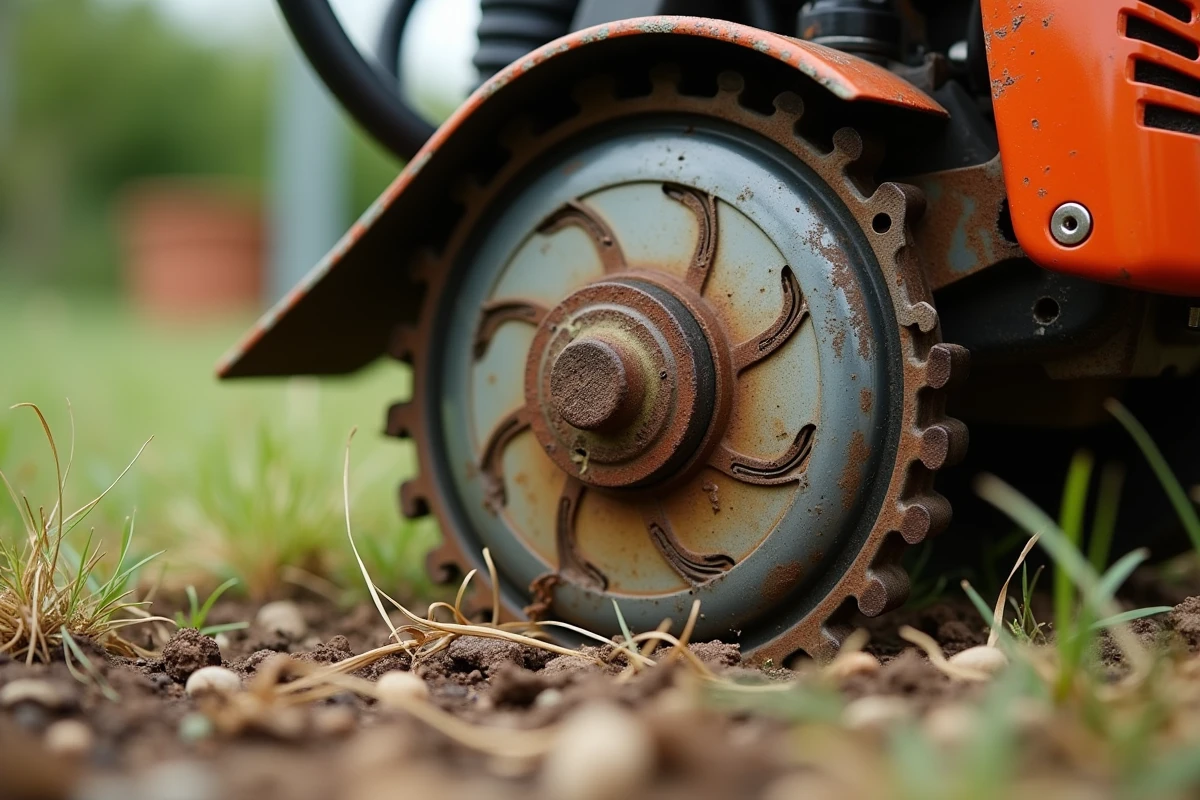
Engine displacement and torque: what really determines cutting capacity
The power displayed in watts is not enough to evaluate a thermal brush cutter. Engine torque is much more critical for the ability to cut through thick brambles than raw power. A modestly sized engine that is well-tuned at low RPMs will perform a cleaner job on dense vegetation than a powerful engine that runs too fast and tears instead of cuts.
Two-stroke engines remain predominant in the thermal segment. Their power-to-weight ratio makes them suitable for long working sessions on hilly terrain. Four-stroke engines, which are heavier, consume less and produce less vibration, but their extra weight can become a handicap on uneven plots.
The choice between line and blade depending on vegetation
The cutting system determines efficiency as much as the engine itself. Here are the main use cases:
- Nylon line is suitable for tall grass and edge finishing. It wears out quickly on rocky areas but poses no risk of dangerous recoil on hard obstacles.
- The three-tooth blade (Tri-Arc type) tackles brambles and young woody regrowth. However, UNEP reports that it dulls approximately 30% faster on rocky soils for entry-level models, necessitating weekly sharpening.
- The multi-tooth grass disc takes over for intensive clearing of dense fallow land, provided there is sufficient engine torque to maintain rotational speed under load.
Starting and ergonomics: the criteria that technical sheets overlook
A comparative test published by L’Echo des Jardins in March 2026 measured the difference between assisted starts and traditional manual starts. Assisted starting systems significantly reduce the pulling effort, a significant factor after an hour of work or for users lacking arm strength.
The type of handle alters posture and perceived fatigue. The bicycle-type handlebar provides the best lateral control for large flat areas. The loop handle, more compact, facilitates movement in cluttered terrain, between trees or along walls. This choice is not trivial: an inappropriate handle for the terrain doubles muscle fatigue during a prolonged work session.

Weight, an underestimated factor
Thermal brush cutters weigh significantly more than their battery-powered counterparts. This extra weight is partially offset by a good carrying harness. Back-distribution harnesses transfer the load to the hips rather than the shoulders, which radically changes comfort during sessions longer than half an hour.
Maintenance of a thermal brush cutter: the real points of vigilance
Maintaining a thermal engine goes beyond mixing oil and gasoline. The air filter, exposed to plant debris, clogs quickly in dusty conditions. A clogged filter raises engine temperature and increases consumption.
The spark plug deserves regular inspection. Gradual fouling results in starting issues and a loss of power under load. On two-stroke engines, the quality of the fuel mixture directly influences the longevity of the piston.
- Clean the air filter after each intensive work session, not just at the end of the season.
- Check the condition of the spark plug every twenty to thirty refuels, or as soon as starting difficulties arise.
- Sharpen or replace the blade as soon as cuts become fibrous instead of clean, indicating a dull edge.
Professionals surveyed by UNEP in their 2025-2026 field study confirm that regular maintenance extends the lifespan of the machine by several seasons. A well-maintained model remains efficient well beyond what its warranty sheet indicates.
The choice of a thermal brush cutter relies on the compatibility between engine torque, the cutting system, and carrying ergonomics. The new noise constraints of 2026 add an additional parameter, but they do not invalidate existing machines if they can be adapted. Testing the weight and handle in real conditions remains the best selection filter, well before the figures on a product sheet.