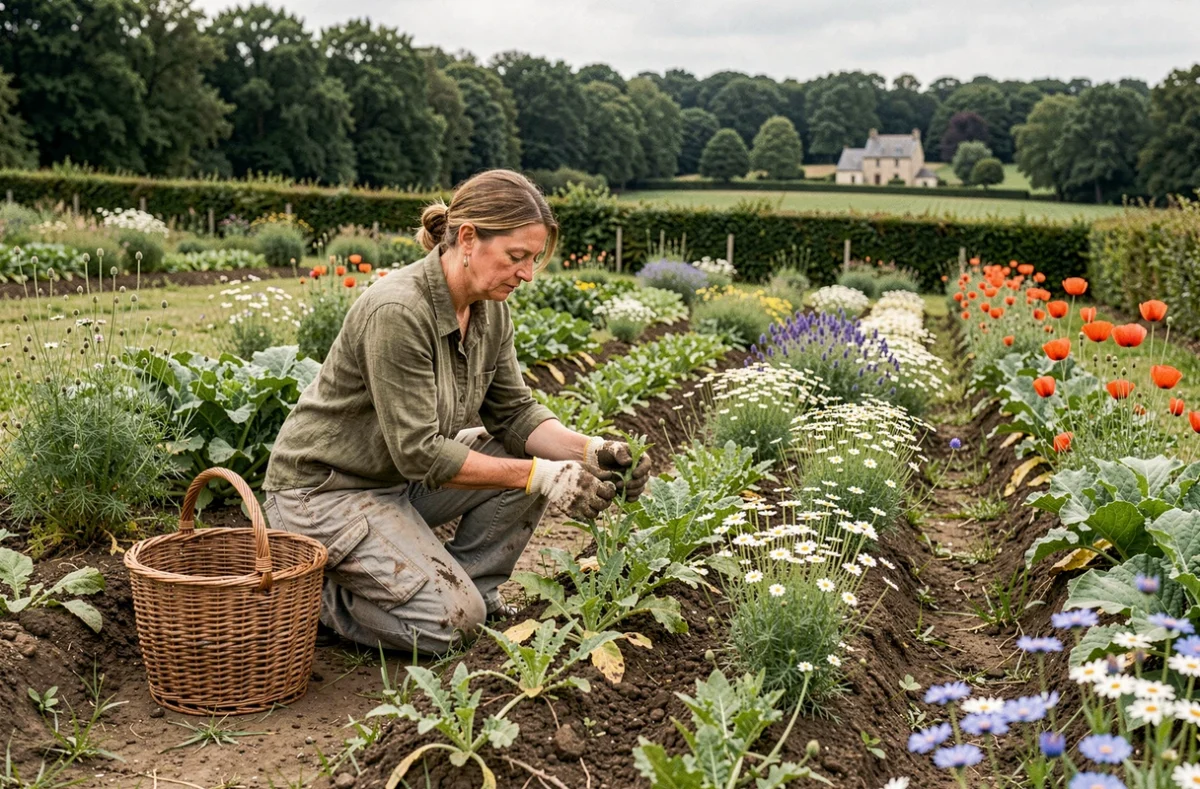
Agriculture shapes most of Europe’s landscapes. Reconciling sustainable agricultural production and biodiversity means understanding how wildlife-friendly features work—not field by field, but across the surrounding landscape. European Regulation 2024/1468 removed the general requirement under GAEC 8 to devote a minimum share of arable land to non-productive features, making the question of incentives and collective action all the more urgent.
Ecosystem services in agriculture: what biodiversity brings to crops
An ecosystem service is a benefit that ecosystems provide to human activities without direct technical intervention. In agriculture, these services include pollination, pest control by natural predators, maintaining soil fertility through decomposer organisms, and filtering water through wetlands and hedgerows.
These processes depend on communities of living organisms (beneficial insects, birds, soil microorganisms) whose presence depends on the diversity of available habitats. A field surrounded by monoculture for several kilometres does not offer the same ecological stepping stones as one set within a network of hedgerows, grassy strips and meadows.
Recent research, including findings synthesised in the EFESE Agricultural Ecosystems study coordinated by INRA, shows that soil and biomass management practices directly determine the condition of these biological components. The challenge is to design a coherent set of practices rather than simply add isolated measures.
For more on the links between agricultural land planning and habitat conservation, see: https://www.agriculture-et-paysage.fr.
Landscape effects on biodiversity: why a single hedgerow is not enough
Planting a hedgerow or maintaining a flower strip can produce very different results depending on the surrounding landscape. In landscapes that are already diverse (bocage, a mosaic of crops and meadows), the additional effect of a new feature on bird populations may be undetectable. In contrast, the same feature can have a significant impact in uniform cereal-growing plains.
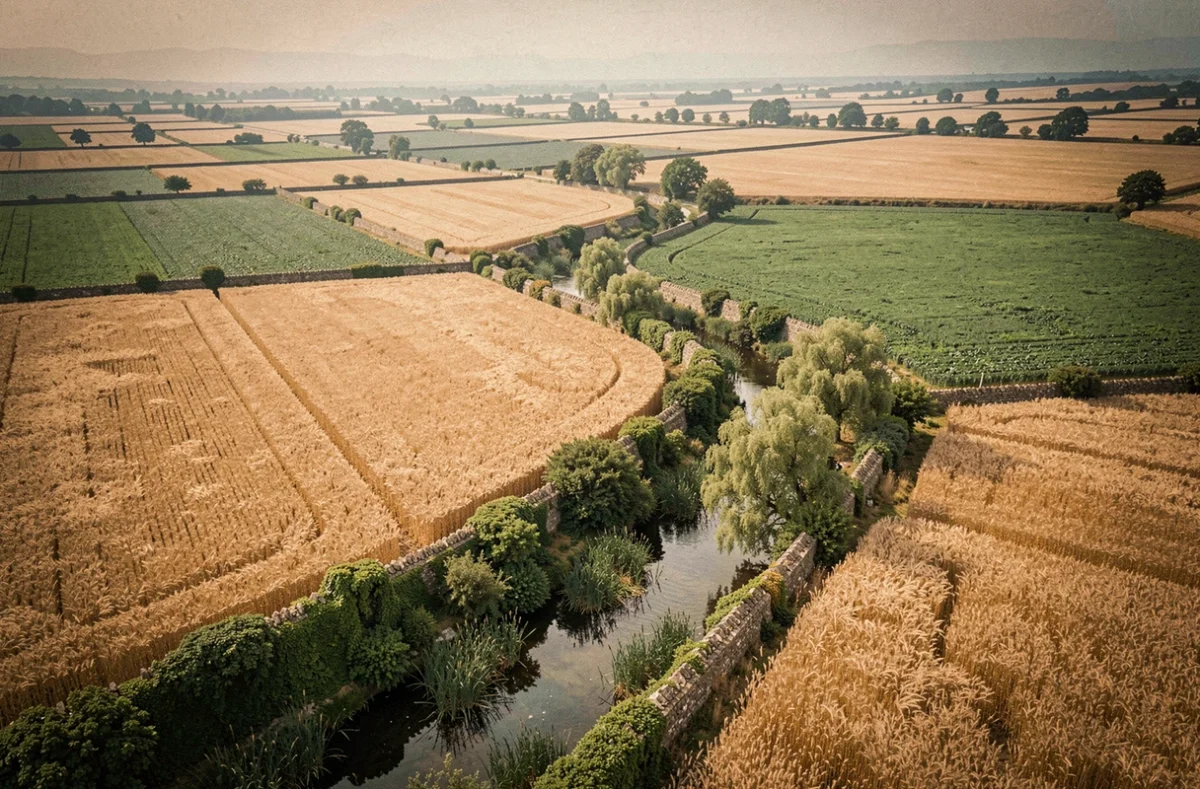
This finding changes how interventions should be planned. Applying a one-size-fits-all approach across the entire region wastes resources where the landscape already provides sufficient diversity, while leaving critical needs unmet elsewhere.
A landscape-scale approach means mapping areas lacking ecological infrastructure before deciding where to focus efforts. Remote sensing tools and graphical parcel registers now make it possible to identify the most uniform areas, and therefore those with the highest priority.
Adapting the size and location of landscape features
An ecological corridor just a few metres wide in an open field spanning several hundred hectares will not, on its own, restore a functional network. The width and continuity of a feature, and its connection to other semi-natural elements, determine how effective it will be.
Requirements to preserve existing landscape features and avoid trimming hedgerows during the nesting season remain in force despite the easing of the CAP rules. These basic requirements provide a minimum foundation, but they are no substitute for a coordinated regional strategy.
Paying for biodiversity-friendly features: the economic barrier
The central problem can be summed up as follows: the benefits of a landscape feature are shared, but its cost falls on the individual. A farmer who plants a hedgerow loses productive land, incurs maintenance costs and receives only a fraction of the benefits, since pollination and pest control also benefit neighbouring fields.
Payments for environmental services (PES) aim to correct this imbalance. Their effectiveness depends on the length of the commitment and the level of payment relative to the actual income foregone. Short-term or underfunded contracts discourage long-term investments such as planting hedgerows, which take several years to become fully functional.
- Agri-environmental and climate measures (AECMs) fund changes in farming practices over five years, but hedgerows take much longer to reach their full ecological potential.
- The one-stop shop for hedgerow removal, currently being rolled out in France, aims to bring together administrative procedures under several regulations without removing the underlying requirements. Compensation arrangements, particularly replanting, will be determined by departmental authorities.
- Labels and certifications (HVE, organic farming) can add commercial value to biodiversity-friendly practices, but the market premium varies across sectors and distribution channels.
Moving beyond individual farms through regional coordination
Since ecological effectiveness depends on the landscape, coordination between neighbouring farms becomes a key lever. Farmer groups, sometimes supported by local authorities or regional nature parks, can jointly plan where to locate hedgerows, grassy strips and flower-rich fallow land to improve ecological connectivity.
This collective approach nevertheless faces practical challenges: different cropping calendars, unsynchronised rotations, and a lack of suitable legal structures for sharing maintenance costs.
Crop diversification and biodiversity: barriers in the supply chain
Growing mixtures of plant species or extending crop rotations benefits both cultivated and wild biodiversity. The agronomic benefits (reduced inputs and greater resilience to climate-related hazards) are well documented.

The challenge lies not in the field, but further down the supply chain. Harvesting, sorting and marketing crop mixtures remains a major obstacle. Sorting equipment is not always available, cooperative and processor specifications often require uniform batches, and markets for cereal-legume mixtures remain limited.
Crop biodiversity therefore depends as much on how supply chains are organised as on farmers’ willingness to diversify. Without suitable collection systems, stable marketing contracts and investment in sorting, diversification remains limited to short supply chains or experimental projects.
Current research programmes are exploring viable business models for these mixed systems, incorporating the value of ecosystem services into selling prices. The transition will not be purely agronomic: it will also require supply chains capable of absorbing and adding value to the diversity produced in the field.