Some models of Yonex rackets are exchanged at prices that far exceed their original value, and the secondary market is full of copies, sometimes sold by recognized retailers. Today, even the serial codes are imitated with alarming precision: it’s impossible to rely on them to ensure the authenticity of a racket.
Official certifications do exist, but their absence does not automatically mean that you are dealing with a counterfeit. Differences in weight, marking details, packaging—these subtle signals often prove to be more revealing than the overall appearance or the mere presence of sealed packaging.
Why do Yonex rackets attract counterfeiters so much?
It’s impossible to overlook the prestige of Yonex. The ArcSaber, NanoFlare, and Astrox series are considered global references, favored by both top-level players and enthusiasts. This aura, combined with sometimes high prices, sharpens the appetite of counterfeiters. The rarity of certain models, the pressure of demand in clubs, the visibility of big names sponsored by Yonex: all contribute to fueling the proliferation of increasingly sophisticated copies.
The official distribution network remains limited. Buying a Yonex racket from a certified store or a recognized site can sometimes feel like an obstacle course, especially for rare or high-end editions. Faced with this difficulty, many turn to alternative channels where guarantees are minimal. This is where the trap closes: a counterfeit Yonex racket can display impeccable finishing while hiding a fragile structure that won’t hold up on the court.
The global demand for high-performance equipment, combined with the brand’s prestige, fuels the rise of fakes. Traffickers refine their methods, duplicating codes, holograms, and even packaging. The authentication of a Yonex racket thus becomes an essential step for anyone wishing to invest without unpleasant surprises: one must pay attention to every detail, compare markings, check provenance through official networks or verification devices offered by Yonex and its partners like Sunrise Yonex. The best weapon is knowledge and sharp vigilance.
Reliable indicators or pitfalls: recognizing a genuine Yonex
Before any purchase, examine the authentic Yonex racket carefully. The Yonex serial number is laser-engraved on the handle: its line should be clear, regular, and without smudges. Ensure that this number matches the one indicated on the invoice if it comes from an official distributor or an authorized store. Another point of control: the hologram, affixed to the shaft. Its appearance changes with the light, its adhesion must be perfect, and it should show no signs of attempted removal or repositioning.
To help you identify the signs that make a difference, here’s what to examine closely:
- Yonex barcode: present on the packaging or the racket, it must be readable, precise, and without fading. A distorted or overly generic code should immediately raise alarms.
- Yonex certificate of authenticity: on some high-end models, this document accompanies the purchase and mentions a Yonex country code as well as a unique numeric code.
- Yonex racket price: an offer that is too low, displaying a broken Yonex price, should raise suspicion. Official market prices do not vary greatly.
The Yonex security device also relies on attention to detail: uniform paint, careful lettering, and total absence of printing defects. A fake Yonex racket will always reveal an anomaly in one of these aspects. Always cross-check all these elements to validate the authenticity of the racket. Despite counterfeiters’ advancements, inconsistencies remain: basic packaging, missing documents, approximate logos. Be vigilant, even when purchasing in clubs or among amateur players.

Step-by-step verification process
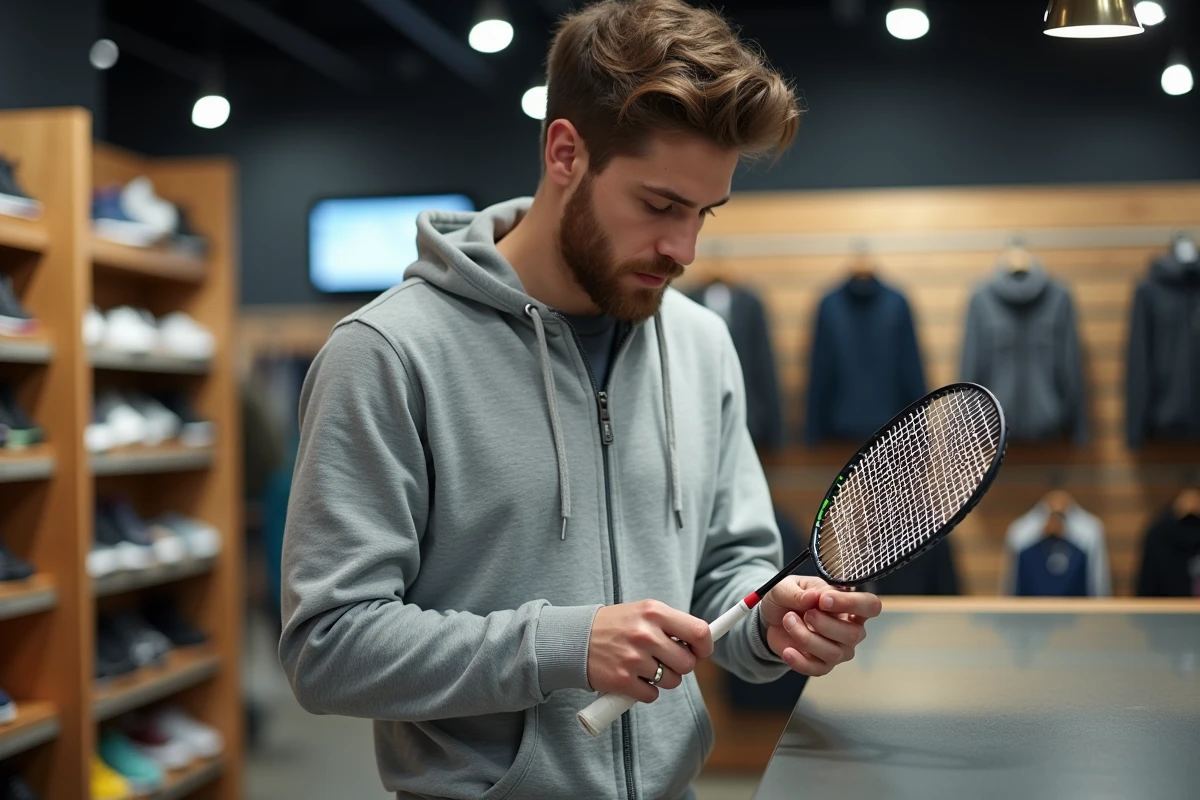
The inspection must be methodical. Start with a meticulous visual analysis of the Yonex racket. The Yonex serial number engraved on the shaft should have a clean cut, without overflow or irregularity. Observe the font, alignment, spacing: the slightest deviation can betray a copy. Then compare this number to the invoice or the certificate obtained from an official Yonex distributor, an authorized Yonex store, or a recognized Yonex site.
The Yonex hologram, another point of control, should react to light, be securely attached, and impossible to remove without leaving traces. On older models, rely on the consistency of the Yonex barcodes and the presence of a Yonex certificate of authenticity, often slipped under the grip or in the packaging.
To leave nothing to chance, check the following points:
- Compare the data of the Yonex country code and the Yonex numeric code with those on the purchase invoice.
- Observe the quality of the paint, the care taken with the logos, the finish of the grip.
- Ensure you have a Yonex racket invoice issued by a known and recognized retailer.
If doubts persist, contact Yonex customer service with all the gathered elements: serial number, barcode, certificate of authenticity. Their team is well-versed in the subtleties of identification. Always prefer validated channels to acquire an official Yonex racket: it’s the best guarantee to avoid unpleasant surprises.
Ultimately, buying a Yonex racket is choosing reliable and high-performance equipment, provided you can see beyond appearances. Increased vigilance, a trained eye, and a trusted network: that’s what separates the true Yonex experience from an unpleasant surprise. The question remains whether the next racket you hold in your hands will live up to all its promises, both on the court and to the naked eye.