One hectare is worth 10,000 square meters, one are is worth 100, and one centiare corresponds to a single square meter. These three units of agricultural area are based on a strict decimal system where each level represents a factor of 100 compared to the next. Mastering their articulation avoids decimal errors that, on a notarial deed or a survey document, can shift an area by a factor of 100.
Decimal Logic of the Hectare-Are-Centiare System and Decimal Traps
The ha/a/ca system operates by powers of 100. Each unit thus occupies two ranks in a conversion table, whereas the classic metric system (meter, decameter, hectometer) progresses by powers of 10 with a single rank per unit. This peculiarity generates the majority of errors.
Specifically, when we convert from hectares to square meters, we shift the decimal point four positions to the right. For an are, two positions. For a centiare, no shift since 1 centiare equals exactly 1 m².
The most common error is to only move the decimal point two positions instead of four when converting from hectares to m². As a result: a plot of 2.5 ha appears as 250 m² instead of 25,000 m². In a sales agreement, this type of confusion has direct consequences on price and taxation. We recommend always writing out the conversion in decomposed form before validating a final figure.
The decomposition of a mixed area (for example, 3 ha 27 a 54 ca) follows a logic of weighted addition: (3 x 10,000) + (27 x 100) + (54 x 1) = 32,754 m². The most reliable method to master the conversion of hectares, ares, and centiares into square meters remains to treat each unit separately and then add the results, rather than manipulating decimals.

Conversion Table from Hectares, Ares, and Centiares to Square Meters
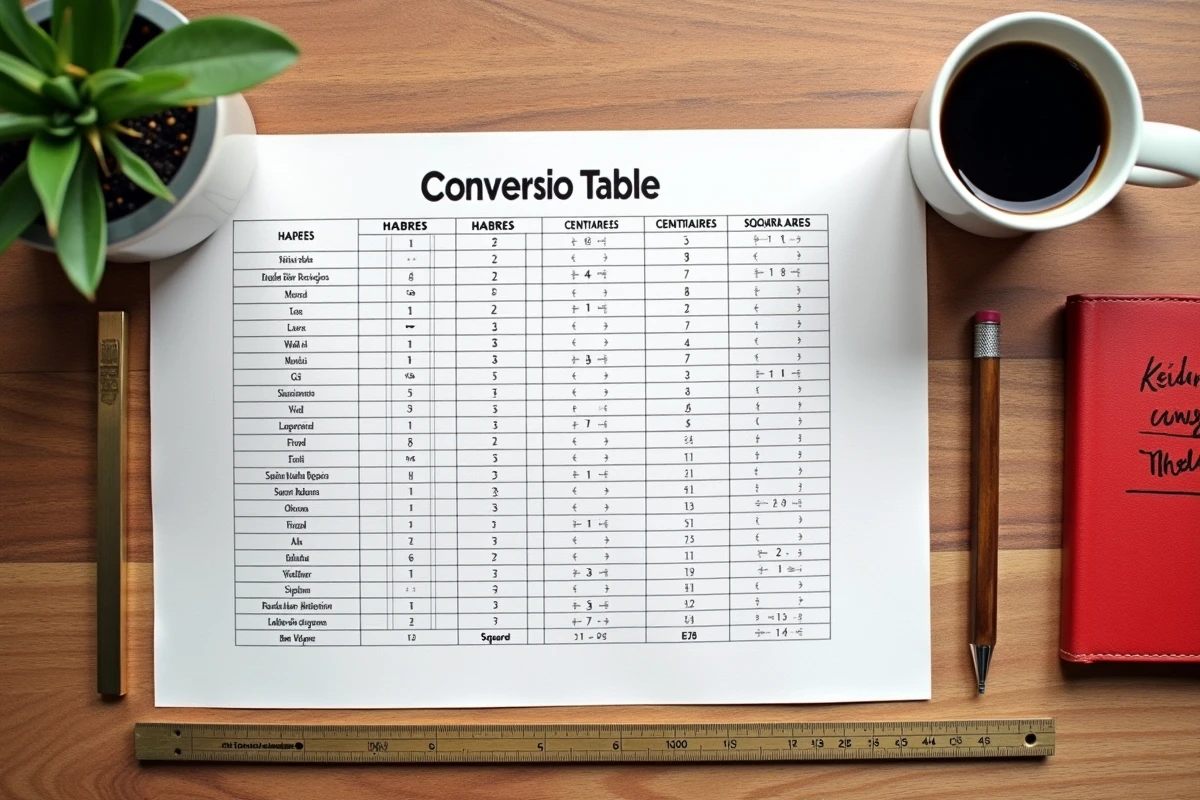
A double-entry table clarifies the relationships between units and limits mental calculation errors.
| Unit | Symbol | Equivalent in m² | Equivalent in ares | Equivalent in hectares |
|---|---|---|---|---|
| 1 centiare | ca | 1 | 0.01 | 0.0001 |
| 1 are | a | 100 | 1 | 0.01 |
| 1 hectare | ha | 10,000 | 100 | 1 |
The “Equivalent in m²” column is the only one that matters for official documents. Notaries express the cadastral area in ha, a, and ca, but the legal area is always verified in square meters.
Quick Reading of a Cadastral Area
On a cadastral survey, the area often appears in the form “02 ha 15 a 30 ca”. Each block of two digits corresponds to a unit. Simply concatenate the blocks to obtain the area in m²: 02 | 15 | 30 gives 21,530 m². This block reading is faster than successive multiplication and eliminates the risk of shifting.
Hectare and Square Meter in Real Estate and Agricultural Deeds
Public real estate listings almost systematically display the area in square meters, including for land. The hectare persists in two specific contexts: agricultural transactions and deeds related to forest plots. Rural land professionals continue to think in hectares because yields, rents, and subsidies are indexed to this unit.
The are and centiare, on the other hand, are gradually disappearing from listings. They remain present in notarial deeds by cadastral convention, but their use is declining in commercial communication. Only the square meter has consensus among all transaction participants.
Case of Old Cadastres and Historical Units
Professionals dealing with old titles still encounter areas expressed in arpents, perches, or acres. In Quebec, official land services provide equivalence tables including the arpent of area and the acre alongside the are and hectare. In mainland France, the old Napoleonic cadastres sometimes used local units whose conversion to the metric system requires specific coefficients, impossible to guess without historical cadastral documentation.
Ensuring Reliable Conversion with GIS Tools and Georeferenced Plans
Manual conversion remains relevant for quick checks, but surveyors and cadastral services now rely on geographic information system (GIS) software and georeferenced digital plans. The legal area in m² comes directly from software calculations, and hectares, ares, and centiares are merely a display result.
This approach significantly reduces errors on complex files: subdivided plots, land consolidations, easements. The GIS recalculates the area with each modification of the perimeter, which a simple conversion table does not allow.
When Manual Calculation is Still Necessary
Resorting to manual calculation is justified in three specific situations:
- Verification of a notarial deed before signing, when the cadastral area is expressed in ha/a/ca and the agreement shows a total in m²
- Quick estimation on the ground, without access to software, to compare an announced area to the perceived reality (one are represents a square of 10 m on each side)
- Cross-checking a GIS survey whose result seems inconsistent with historical cadastral data
In each of these cases, the decomposition method (ha x 10,000 + a x 100 + ca x 1) remains the only reliable verification without digital tools.
Mastering these conversions is not a school exercise. It conditions the correct reading of any land document, from a simple property survey to the authentic deed. Keeping in mind the factor of 100 between each level and systematically applying the decomposition by unit is enough to eliminate almost all errors encountered in practice.