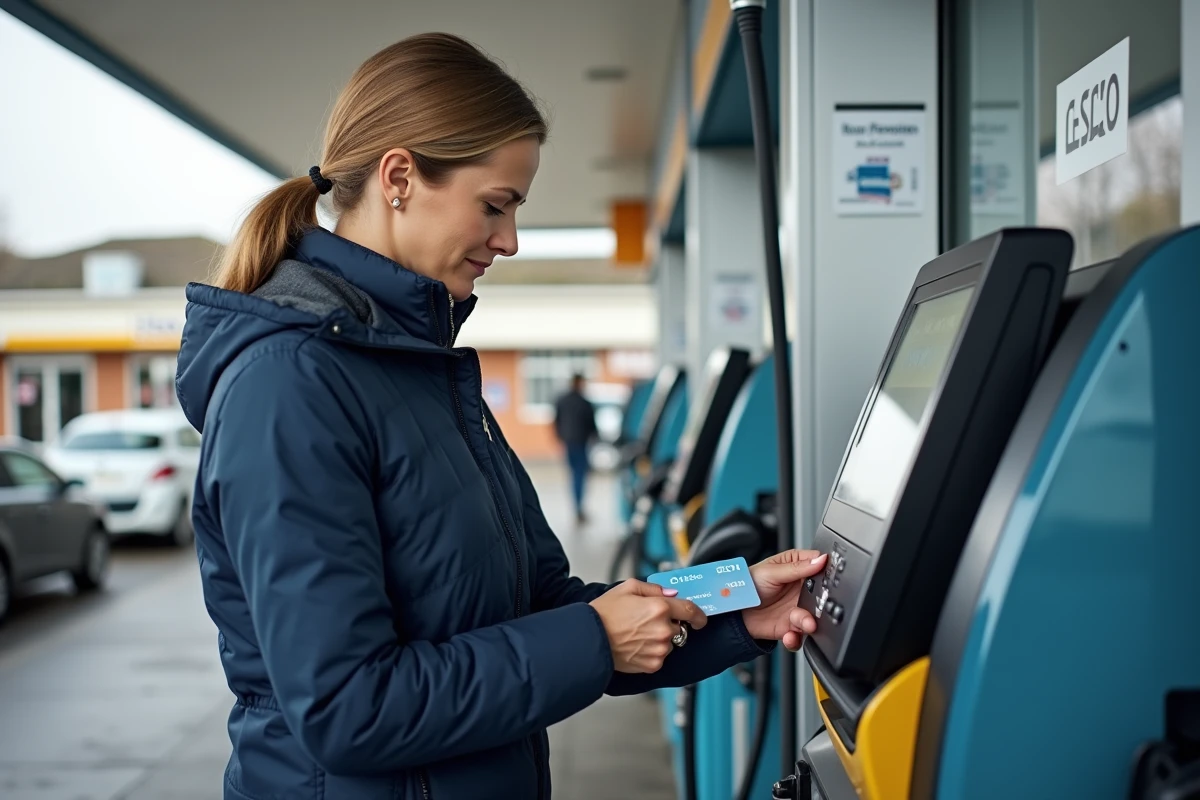
The holiday voucher, whether paper or in Connect format, remains a payment method reserved for a specific range of expenses related to leisure, tourism, and culture. Finding a gas station that accepts this payment method for a full tank of fuel is often a journey filled with misunderstandings. The confusion largely stems from the presence of certain stations in the ANCV Guide, without the “fuel” category being relevant.
ANCV-registered highway station: what acceptance really covers
The online ANCV Guide (leguide.ancv.com) lists highway gas stations in its results. Their presence in the directory often leads to a misunderstanding: many motorists assume they can pay for their fuel with holiday vouchers.
In reality, these stations appear under the fast food or shop category, not under a fuel category. A multi-service highway station may accept holiday vouchers for a sandwich, a coffee, or a shop purchase, while refusing this payment method at the pump. This distinction is rarely clarified on the provider’s sheet.
This ambiguity also affects the dematerialized format. The Holiday Voucher Connect works via a code to be presented at the checkout or on a mobile app, but the network of partners remains the same: if fuel is not covered in paper format, it is not covered in digital format either. Searching for a gas station accepting vouchers and holiday vouchers for fuel often leads to a contractual deadlock with the ANCV.

Payment by bank check at gas stations: a declining acceptance
The question of the classic bank check arises differently. No regulation prohibits a merchant from accepting checks, but nothing obliges them to do so either. Gas stations belonging to large retail networks (hypermarkets, supermarkets) still often accept bank checks because the payment policy is that of the brand as a whole.
Automatic stations without staff systematically refuse checks. They operate exclusively by credit card, sometimes with pre-authorization. This model is rapidly developing, including in rural areas where it replaces struggling traditional stations.
Large retail stations and bank checks
Stations affiliated with Leclerc, Carrefour, Intermarché, or Super U generally have a checkout with staff during store opening hours. Bank checks are accepted there under the same conditions as for grocery shopping: ID, sometimes a minimum amount.
However, after checkout hours, these same stations switch to automatic mode. The check is no longer an option then. It is necessary to check the checkout hours, which do not always correspond to the hours of access to the pumps.
Independent and franchised stations
Brand stations (TotalEnergies, Esso, BP) operated by independent managers sometimes maintain a more flexible policy. The decision lies with the manager. Some continue to accept checks to retain local customers, while others have stopped due to cashing delays and the risk of non-payment.
No centralized directory lists stations accepting bank checks. The information can only be confirmed by a phone call or by visiting the site.
Holiday vouchers and fuel: the workarounds that circulate
Faced with the impossibility of paying directly for fuel, several workaround strategies circulate online and in specialized forums.
- Using holiday vouchers to pay for accepted mobility services (vehicle rental, train tickets, tolls in some cases), which frees up the current budget for fuel. This approach does not convert vouchers into fuel but reorganizes the expense categories.
- Some fleet managers combine dedicated fuel cards and holiday vouchers allocated to accommodation or meal expenses for traveling employees. Fuel is covered by the card, while holiday vouchers absorb other eligible expenses.
- Checking if the shop or restaurant part of a highway station accepts holiday vouchers allows at least to cover ancillary expenses of a trip (meals, drinks, snacks), even if the pump remains excluded.
None of these methods allow for paying for fuel with a holiday voucher. They optimize the allocation of the overall budget without changing the scope defined by the ANCV.
Check acceptance before traveling: tools and limits
The online ANCV Guide is the logical starting point for identifying partners accepting holiday vouchers. The search engine allows filtering by type of service and geographical area. The list of partner brands covers accommodation, dining, leisure, and transportation.
Fuel does not appear in any category of the ANCV Guide. The sheets for highway stations returned by the engine correspond to their fast food or retail activity.
For the classic bank check, the approach remains artisanal. A few concrete tips:
- Call the station before going there, specifying the desired payment method.
- Prefer large retail stations during checkout hours.
- Check recent online reviews: some users mention accepted payment methods, even if the information ages quickly.
Fuel price comparison apps (like the government’s Prix-Carburants) do not include a filter by payment method. This criterion remains absent from public digital tools.
What the ANCV framework could change in the long term
The ANCV has gradually expanded the scope of the Holiday Voucher Connect to include mobility services: vehicle rentals, certain tourist VTCs, collective transport services. This evolution shows a willingness to integrate mobility into the offering.
However, fuel remains a common expense, not specifically tourist-related, which complicates its integration into a system designed for leisure and vacations. The available data does not allow for concluding that an expansion to fuel is planned in the short term.
The boundary between tourist spending and daily spending poses a definitional problem that the ANCV has not publicly resolved. Fuel purchased on a vacation trip and that purchased for commuting passes through the same pump, making any usage control practically impossible.