
On a QWERTY keyboard, the letter M is located on the bottom row, between the N key and the comma. This position, mundane for an English speaker, confuses most French speakers who are used to the AZERTY keyboard, where M occupies the middle row, just to the right of L. Understanding this difference in layout allows for typing without hesitation, regardless of the keyboard under your fingers.
Why M changes position between AZERTY and QWERTY keyboards
The names AZERTY and QWERTY simply refer to the order of the first six letters of the top row. Behind this convention lies a linguistic logic: each layout optimizes the placement of the most frequent characters in the target language.
In French, M often appears at the end of words or in common combinations (em, om, am). The AZERTY keyboard places it on the central row, accessible to the right index finger without vertical movement. In English, letter frequencies differ, and the bottom right row of the QWERTY accommodates M next to N, facilitating the typing of sequences like “man,” “men,” or “ment.”
The arrangement of keys around M on a QWERTY follows this logic: N on the left, comma on the right, J above. To locate the M key on a QWERTY keyboard, simply spot the letter N and slide a finger to the right.

QWERTY layout: locating M on the bottom row
The bottom row of a standard QWERTY keyboard contains, from left to right: Z, X, C, V, B, N, M, followed by punctuation marks (comma, period, slash). M occupies the seventh position on this line, just before the comma.
On an AZERTY keyboard, this location corresponds to the semicolon. It is this precise substitution that causes the most common error: typing a semicolon instead of M when switching from one keyboard to another.
US and UK QWERTY keyboard variants
The position of M remains the same between the US and UK QWERTY variants. The differences between these two versions mainly concern symbols and special characters (at sign, quotation marks, hash), not letters. Identifying the correct variant is useful to avoid surprises with punctuation, but the M key does not move.
Compact and ultraportable keyboards
On some recent ultraportables, the width of the border keys is reduced to save space. The M key, close to the right edge, may be slightly narrower and closer to the space bar. This ergonomic detail, frequently mentioned in user feedback on compact models, deserves attention when purchasing if smooth typing is a priority.
Windows keyboard shortcuts to switch between QWERTY and AZERTY
The unintentional switch from AZERTY to QWERTY is a common issue on Windows. It usually occurs after accidentally pressing a language change key combination.
- On Windows 10 and 11, the shortcut Alt + Shift toggles between installed languages. An accidental press is enough to switch from French (AZERTY) to English (QWERTY) without any visible notification on the screen.
- The shortcut Ctrl + Shift changes the keyboard layout within the same language if multiple layouts are configured.
- The taskbar displays a language indicator (FR, EN, ENG) at the bottom right. Clicking on it allows you to manually return to the desired layout.
To avoid these unintentional switches, the most reliable solution is to remove unused keyboard layouts. In Windows settings, under Time & Language, then Language & Region, each installed language offers keyboard options. Removing the English layout prevents any accidental switching.
Virtual keyboard and visual check of the layout
Windows includes an on-screen keyboard tool that visually displays the active layout. To activate it, open the accessibility settings or type “on-screen keyboard” in the search bar.
This virtual keyboard reflects in real-time the selected layout. If the system is in QWERTY, M appears between N and the comma on the bottom row. In AZERTY, it moves up to the right of L on the central row. This is a quick way to check which layout is active without testing each key blindly.
On mobile: beware of floating keyboards
On Android and iOS, the position of M depends on the configured language and display mode. Floating keyboards or one-handed mode can unexpectedly shift the keys. Bilingual users who switch between AZERTY and QWERTY on their phones frequently encounter this confusion.
The workaround is to check the active language before typing. On most mobile keyboards (Gboard, SwiftKey, Apple keyboard), a long press on the space bar or globe icon allows switching between installed layouts.
Three concrete methods to memorize the position of M in QWERTY
Locating M once is not enough. Muscle memory takes time to adapt, especially for users who alternate between the two layouts.
- Fixed spatial reference: M is always two keys to the left of the space bar (right side). This reference works on all QWERTY keyboards, including compact models.
- Typing common words: regularly typing English words rich in M (memory, morning, moment) forces the fingers to integrate the new position. A few minutes a day for a week is enough to create the automation.
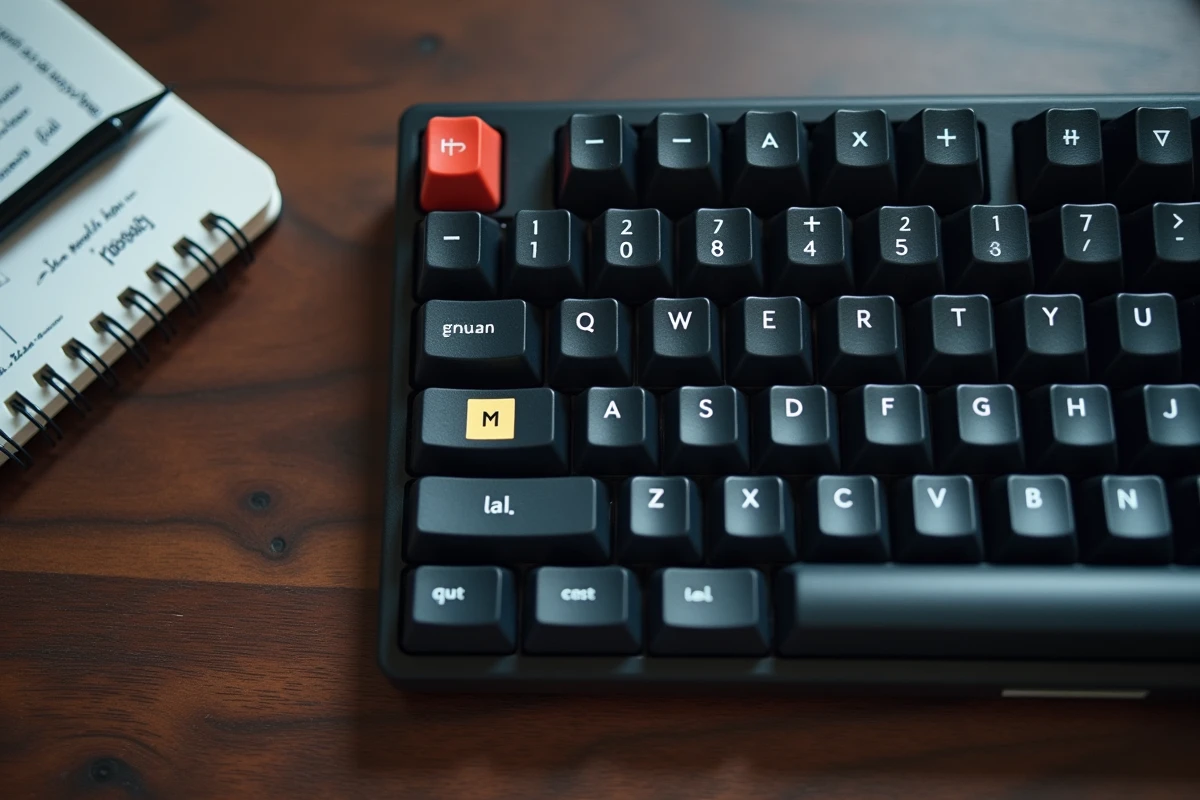
- Tracking stickers: placing a small colored sticker on the M key of a QWERTY keyboard provides a temporary visual reference until muscle memory takes over.
Adapting to a new keyboard relies on repetition rather than theoretical memorization. The brain eventually associates the gesture with the correct location, provided not to alternate too often between the two layouts during the learning phase. For those who must use both daily, configuring an explicit keyboard shortcut (rather than Alt + Shift) and removing automatic switches remains the most effective measure to avoid searching for letters.